
 What Makes Ayurvedic Massage Different at Samya Spa?
Most people recognize Ayurvedic massage by its warm oils, flowing movements, and deeply calming rhythm. Those are all important parts of the experience, but they are only the surface of the treatment.
At Samya Spa in Victoria, Ayurvedic massage is not approached as a single fixed routine. There are many forms of Abhyanga and many ways to structure an Ayurvedic body treatment. Rather than offering the same sequence to every client, our work is adapted to the individual.
The treatment may feel gentle, fluid, and deeply relaxing, but beneath that calm experience is a more precise method of observation, touch, rhythm, and sequencing.
More Than a Massage Routine
Many Ayurvedic spa treatments rely on a standard sequence: oil is applied, the massage follows a set pattern, and the treatment is repeated in a similar way for each client.
At Samya Spa, the sequence is adjusted based on the person receiving the treatment. The practitioner considers the client’s presentation, body tone, reactivity, temperature, posture, texture of the tissues, and overall state. From there, the pace, pressure, direction, and flow of the massage are adapted.
This is one of the main differences between a general oil massage and individualized Ayurvedic bodywork.
The treatment is not only about applying oil. It is about how the oil is applied, where the body needs steadiness, where it needs softening, where there is resistance, and how the whole system responds during the session.
The Role of Dosha in Ayurvedic Massage
Ayurveda understands the body through the doshas: Vata, Pitta, and Kapha. These principles describe patterns of movement, heat, structure, fluidity, stability, sensitivity, and change.
In an Ayurvedic massage, all three doshas may be considered. However, Vata often plays a central role because it governs movement and coordination throughout the body.
When Vata is understood properly, massage becomes more than a sequence of strokes. It becomes a way of working with the body’s natural directions of movement, circulation, sensation, and internal flow.
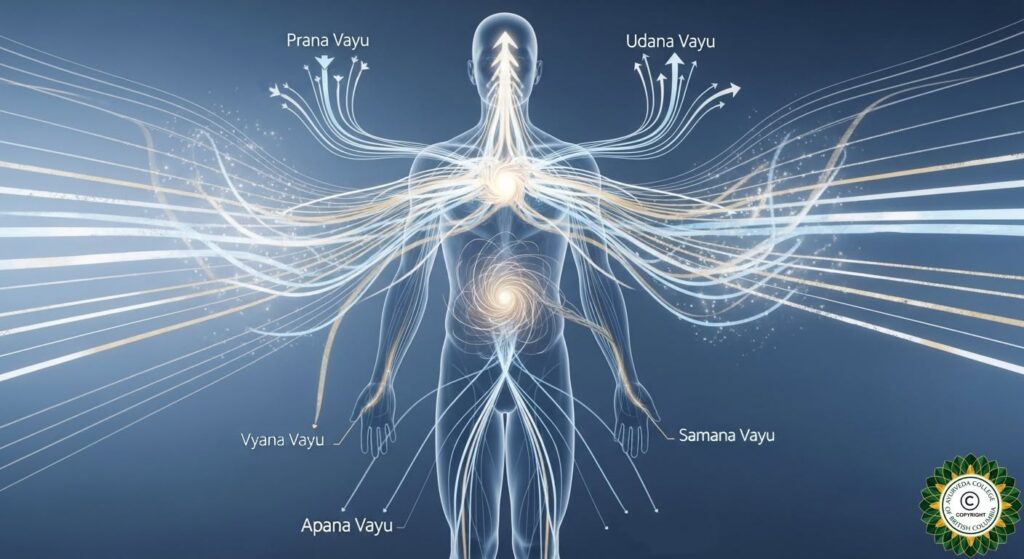
The Five Movements of Vata
In Ayurveda, Vata is traditionally described through five primary subtypes, often called the five Vayus. Each Vayu has a natural direction and function in the body.
Prana Vayu is associated with inward movement, breath, sensory intake, and the nervous system’s ability to receive and respond.
Udana Vayu is associated with upward movement, expression, effort, speech, and the body’s capacity to rise and project energy outward.
Vyana Vayu is associated with circulation, expansion, nerve flow, and whole-body coordination.
Samana Vayu is associated with digestion, assimilation, metabolism, and the body’s ability to gather and process internally.
Apana Vayu is associated with downward movement, elimination, grounding, and release.
These are not treated as abstract ideas during bodywork. They help guide the direction, rhythm, and quality of the massage.
How This Shapes the Treatment
During an Ayurvedic massage at Samya Spa, the practitioner observes how the body presents before and during the treatment. This may include noticing muscle tone, skin resistance, warmth or coolness, sensitivity, posture, reactivity, and the way the body receives touch.
The treatment is then adjusted accordingly.
A client who feels scattered, restless, or overstimulated may need a slower, warmer, more grounding approach. A client who feels heavy or stagnant may need a more activating rhythm. A client with sensitivity or tension may need the treatment to begin gently before deeper work is introduced.
This is why two clients may book the same Ayurvedic massage service but receive a different sequence, pressure, pace, or treatment emphasis.
Why Warm Oil Matters
Warm oil is one of the defining features of many Ayurvedic body therapies. It softens the skin, supports a feeling of warmth and comfort, and allows the massage to flow smoothly across the body.
In Ayurveda, oil is traditionally associated with nourishment, stability, and grounding. This makes it especially important in treatments intended to calm, settle, and restore.
At Samya Spa, the use of oil is not simply cosmetic. It is part of the therapeutic language of the treatment. The amount of oil, the pace of application, the direction of movement, and the way the body absorbs or resists the treatment all provide useful information to the practitioner.
Calm on the Surface, Precise Beneath
A well-performed Ayurvedic massage should not feel complicated to the client. The experience should feel warm, fluid, steady, and deeply calming.
The precision is underneath the surface.
The practitioner is quietly adjusting the treatment based on what is observed through touch and presentation. The rhythm may slow down, the pressure may change, the direction of movement may be refined, or the sequence may shift to better support the person receiving the massage.
This is what makes Ayurvedic bodywork different from a mechanical routine.
Ayurvedic Massage at Samya Spa in Victoria
At Samya Spa, Ayurvedic massage is shaped by traditional Ayurvedic principles, practical bodywork experience, and individualized care.
Our treatments are designed to be calming, restorative, and responsive to the person in front of us. Whether the session includes Abhyanga, warm oil massage, head massage, foot massage, steam, or other Ayurvedic body therapies, the goal is to offer a treatment that feels both deeply relaxing and thoughtfully guided.
That is what defines Ayurvedic bodywork at Samya Spa.
To experience Ayurvedic massage in downtown Victoria, book online or contact Samya Spa for guidance in choosing the right treatment.