
Why More Pressure Isn’t Always Better
One of the most common requests many therapists hear during a deep tissue massage is:
“Can you press harder?”. It’s an understandable request.
Many people have come to associate a good massage with pressure. Some believe if the treatment hurts, it must be working. If they’re sore afterwards, they assume it was effective. There is some truth in that.
Working with long-standing muscular tension, old injuries, restricted movement, or dense connective tissue can be uncomfortable. Deep tissue massage is designed to work with deeper structures of the body, and there are many situations where firm, sustained pressure is exactly what those tissues require.
But pressure alone is not the treatment. It is only one way of influencing the body. The question is not how much pressure can be applied. The question is what the body is responding to.
Deep Tissue Massage Is Not One Technique
One of the biggest misconceptions about deep tissue massage is that it refers to a particular style of massage. It doesn’t.
Deep tissue massage is better understood as a therapeutic approach than a single technique
Different tissues respond to different types of mechanical stimulation. Sometimes that means sustained pressure. Sometimes it means rhythmic movement. Sometimes it means friction, stretching, joint mobilization, vibration, percussion, or working through movement rather than compression.
An experienced practitioner may use several of these approaches during the same treatment.
The pressure, speed, rhythm, direction and sequence are constantly changing in response to the tissues being treated. This is why deep tissue massage cannot be measured by pressure alone.
The pressure is only one part of a much larger clinical decision.
Different Tissues Behave Differently
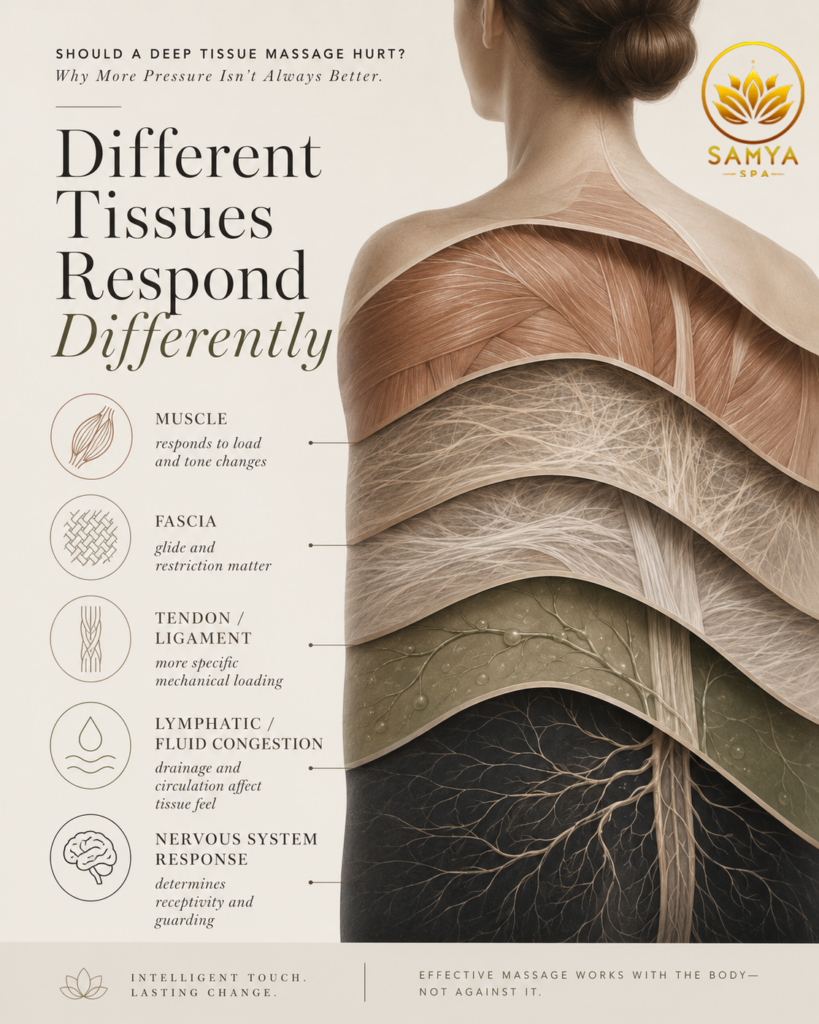
When people think about massage, they usually think about muscles. Muscles are only one part of the picture. Every treatment also involves fascia, tendons, ligaments, joints, nerves, blood vessels, lymphatic vessels, and the connective tissues that allow all of those structures to move together. Each behaves differently.
Healthy muscle responds differently than chronically contracted muscle. Scar tissue behaves differently than healthy fascia. An inflamed tendon requires a different approach than a dense muscle belly. Congested tissue responds differently than tissue with healthy circulation.
Trying to treat every one of these structures with the same amount of pressure would make little clinical sense. The skill lies in recognising what is being felt beneath the hands and selecting the most appropriate method of treatment.
The Body Is Constantly Responding
Massage is often described as something that is done to the body. As though the therapist is working a piece of inert clay. In reality, the body is responding throughout the entire treatment.
Every change in pressure, rhythm and movement is interpreted by the nervous system. Some mechanical input encourages tissues to soften. Other forms of input encourage movement. Others improve circulation or lymphatic drainage. Some stimulate. Others calm. At the same time, the practitioner is observing how the tissues respond. Does the tissue begin to soften? Does movement improve? Is the body accepting the treatment or beginning to guard against it?
Those observations determine what happens next. The treatment is continually adapting.
Why More Pressure Isn’t Always More Effective
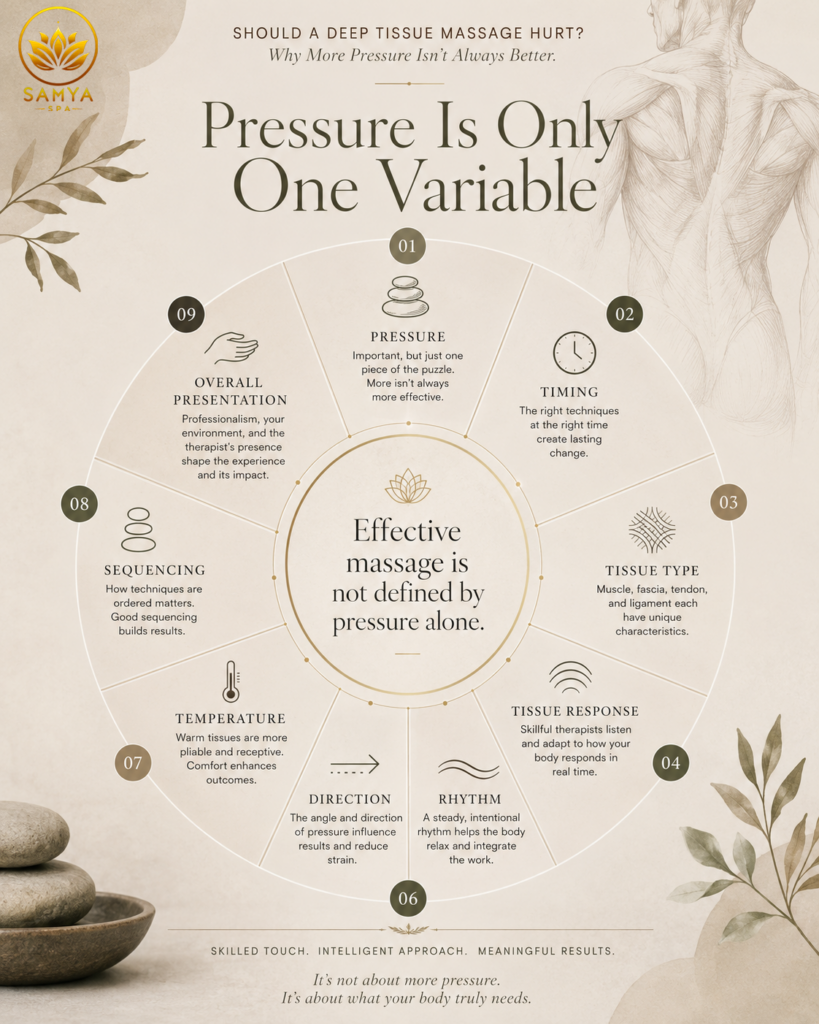
One of the more interesting things we see in practice is that some clients feel they need enormous pressure before they can feel anything at all.
Many assume this means they simply need a stronger therapist. That often isn’t the case.
When tissues have become chronically congested, circulation is reduced, lymphatic drainage becomes less efficient, scar tissue restricts normal movement, and the ability of different tissue layers to communicate and interact with one another diminishes.
The result is often a feeling of heaviness, stiffness, or reduced sensitivity. Nerves no longer communicate signals normally and often the client doesn’t feel the depth of the work being done.
Pressing harder into such congested tissues often doesn’t improve their condition nor provide therapeutic benefit. In some cases it simply creates more inflammation in tissue that is already irritated.
Often a better result comes from improving tissue mobility first, restoring circulation, reducing congestion, and allowing the deeper structures to become more responsive before introducing greater pressure. When such accumulated blockages are cleared, this allows the practitioner to work more deeply with less discomfort than would have been possible at the beginning of the treatment.
Productive Discomfort Is Different From Protective Pain
A well-performed deep tissue massage can absolutely feel intense. Intensity is not the question. The question is how the tissues are responding. Does the intensity encourage release, or does it trigger the body’s protective response?
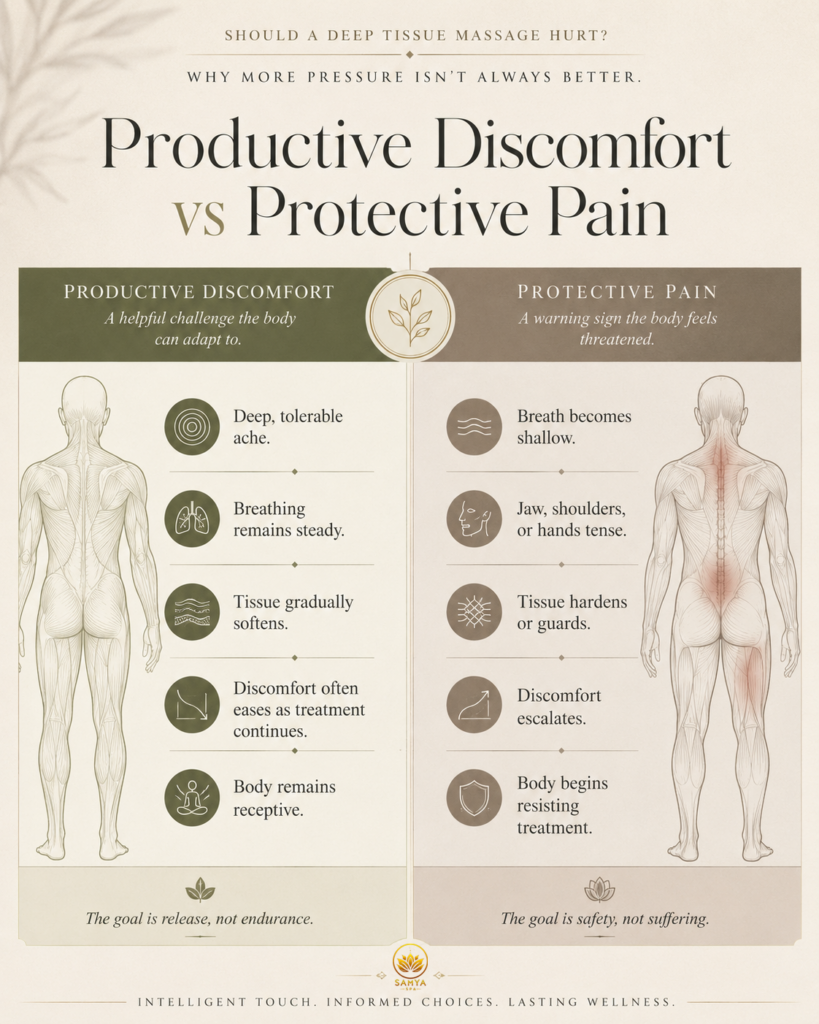
Productive discomfort often feels like a deep, satisfying ache. Breathing remains steady, and as the treatment continues, the sensation gradually becomes more comfortable as the tissues begin to release.
Protective pain feels different. The discomfort becomes sharp, overwhelming, or causes the body to brace. Breathing becomes shallow, muscles tighten instead of releasing, and the body begins resisting the treatment rather than responding to it.
An experienced practitioner works close to that therapeutic boundary while continually monitoring how the body responds. The goal is to encourage release—not provoke a protective reaction.
That is one of the reasons experience matters.
The Ayurvedic Perspective
The principle that different tissues require different therapeutic approaches is not unique to modern massage therapy. It has been central to Ayurvedic bodywork for thousands of years.
Rather than viewing massage as a single technique that simply becomes “deeper” with more pressure, Ayurveda developed multiple systems of therapeutic bodywork, each intended to achieve a different therapeutic effect.
Abhyanga emphasizes nourishment, lubrication, coordinated movement, and nervous system support. Mardana (also known as Vishesh) incorporates deeper techniques to address more established muscular and fascial restriction. Samvahana demonstrates that gentle touch can produce profound therapeutic effects without relying on heavy pressure, while Udvartana uses herbal paste and Ubtan uses herbal powders instead of oils to create an entirely different mechanical interaction with the skin, superficial fascia, muscles and lymphatic system. While each therapy has a targeted purpose, an experienced Ayurvedic practitioner will adapt techniques and sequencing to the individual within each different modality.
That same philosophy extends throughout the massage therapies we offer at Samya Spa. Whether you choose a Deep Tissue Aromatherapy Massage, Organic Aromatherapy Massage, Hot Stone Massage, Reflexology Therapy, Maternity Massage, Couples Massage, Indian Head Massage or Foot Massage, or another therapeutic bodywork treatment, each has been developed with different therapeutic goals in mind. The treatment you choose is the starting point; the therapist’s skill lies in continually adapting the pressure, rhythm, pace, and techniques within that treatment according to how your body responds.
Ultimately, effective bodywork is not defined by how much pressure is applied. It is defined by selecting the right treatment, applying the right techniques, and responding intelligently to the tissues beneath the hands.
Experience Is the Difference
People often assume the best therapist simply has stronger hands. In reality, the best therapist is rarely the strongest one but instead one who has developed the greatest ability to communicate with the body.
Experience changes something far more important than strength. It changes how a therapist observes, interprets, and responds to what is happening beneath their hands: Recognizing which tissues are being treated; Understanding how those tissues are responding; Knowing when greater pressure is appropriate and when another technique is likely to produce a better outcome; Recognizing when the painful area is the source of the problem, and when it is simply where the body is expressing it.
These decisions are being made continuously throughout every treatment. They are what transform massage from a routine sequence of techniques into truly individualized therapeutic bodywork.
A Better Way to Think About Deep Tissue Massage
So, should a deep tissue massage hurt?
Sometimes.
But pain has never been the measure of an effective treatment. Deep tissue massage is not about applying the greatest possible pressure. It is about selecting the most appropriate treatment and techniques for the tissues being treated and adjusting that treatment as the body responds.
Sometimes that requires firm, sustained pressure. Sometimes it requires movement. Sometimes it requires warmth, rhythm, or a completely different approach altogether.
At Samya Spa, our treatments are guided by anatomy, clinical observation, and the individualized principles of Ayurveda. Because effective bodywork is never defined by how hard a therapist can press. It is defined by how intelligently they can read the body in front of them and choose the approach that will produce the best results.
Finding the right balance of pressure and technique makes all the difference in how your body responds.
If you’re looking for a massage in Victoria that listens to your body rather than simply blindly applying more pressure, our practitioners would be happy to help. Every treatment is tailored to your individual needs using thoughtful assessment, appropriate techniques, and pressure that works with your body rather than against it. You can book online or give us a call—we’re always happy to help you choose the treatment that’s right for you.
Further Reading and Clinical References
For those interested in the scientific frameworks behind these physiological responses, several key studies illuminate the mechanisms of manual therapy.
Dr. H. M. Langevin and Dr. K. J. Sherman published an extensive examination titled “Pathophysiology of Myofascial Pain: Clinical and Research Implications” in Evidence-Based Complementary and Alternative Medicine, which details how mechanical stretch causes fibroblasts to remodel connective tissue architecture.
Additionally, a comprehensive study by Dr. J. E. Bialosky titled “The Mechanisms of Manual Therapy in the Treatment of Musculoskeletal Pain: A Comprehensive Model” in Manual Therapy explores how strategic manual pressure down-regulates central nervous system sensitivity and reduces motor neuron activity.
Finally, research by Dr. C. Stecco titled “Hyaluronan within fascia in the etiology of myofascial pain” in Surgical and Radiologic Anatomy investigates the exact role of hyaluronan densification, demonstrating how mechanical shears strain and warmth restore essential tissue glide.